Ashgabat: what to see, facts and flights
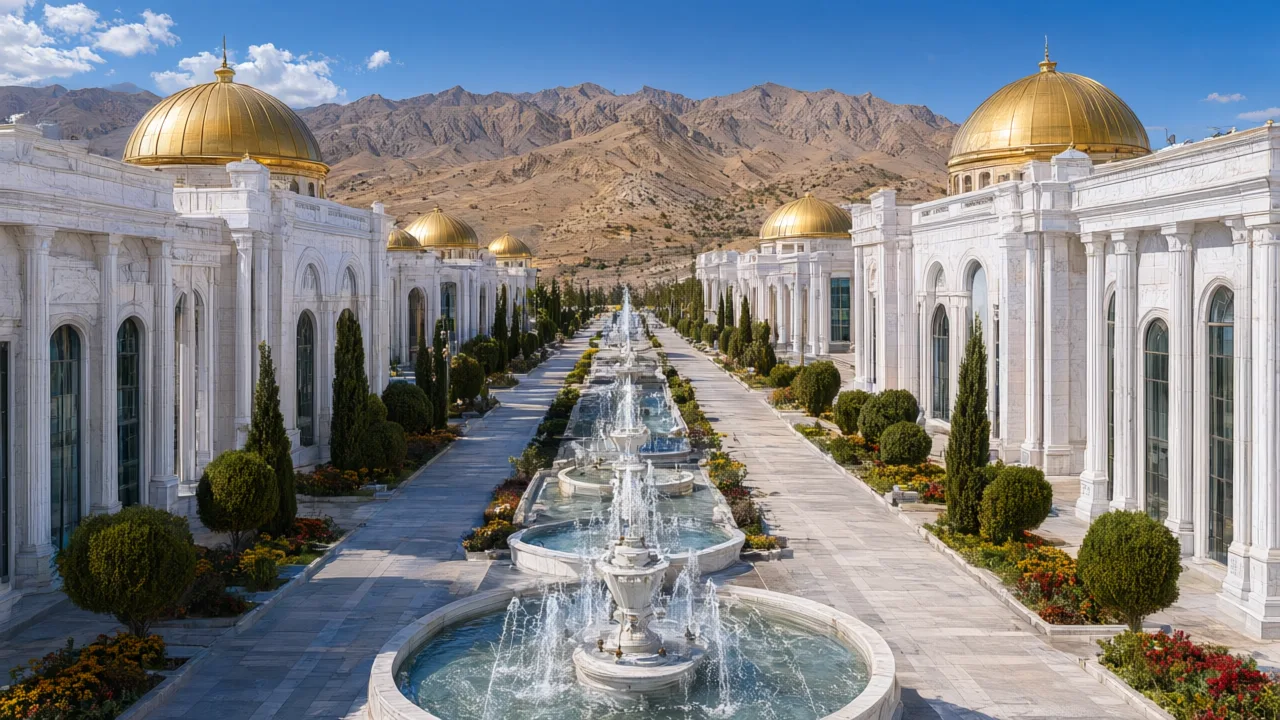
Ashgabat is the capital of Turkmenistan, a Central Asian country with a closed political regime and an economy based on natural gas. The city stands out for its white marble architecture, an urban project that combines colossal monuments, wide avenues and planning that prioritizes institutional image over daily life. People travel to Ashgabat mainly out of historical curiosity and for its uniqueness: it is a capital built almost from scratch in the 21st century, with few leisure spaces and evident state control.
What to see
The center of Ashgabat is an open-air museum of white marble. The main avenue, Bitarap Turkmenistan, concentrates government buildings and the Monument to Neutrality, a three-legged arch crowned by a golden statue that rotates to follow the sun. The Ertugrul Gazi Mosque, in Ottoman style, is one of the few places of worship open to the public and stands out for its size and for being surrounded by gardens.
The other major landmark is the Independence complex, with a central column and a statue of former president Saparmurat Niyazov. Most buildings can be photographed from the outside, but access to interiors is usually restricted. There is no old town: the city was destroyed by an earthquake in 1948 and rebuilt afterwards, first in Soviet style and then with the current aesthetic.
Districts and how to get around
Ashgabat does not have districts with their own identity like those of other capitals. The city is divided into residential districts of apartment blocks and administrative zones. The best way to get around is by taxi or private car, as distances are long and public transport is scarce and unreliable. Walking through the center is possible, but extreme heat in summer makes it unfeasible during the day.
Independence Park and the promenade along the Karakum Canal are the only relevant green areas. At sunset, the illuminated fountains and monuments create an artificial but photogenic atmosphere. There is no traditional market district in the center; the most well-known bazaar, Tolkuchka, is on the outskirts and operates mainly on weekends.
Museums and theaters
The National Museum of History, next to the airport, is the most complete cultural visit: it displays archaeological finds, carpets and objects from the Soviet era. The Carpet Museum, in the center, is essential to understand local craftsmanship, with large pieces and explanations about tribal designs. Both have limited hours and usually close on Mondays.
The main theater is the National Drama Theater, with plays in Turkmen and Russian. Performances are infrequent and usually not subtitled, so it is not a priority option for a foreign traveler. Opera and ballet do not have a permanent venue in the city.
Nearby getaways
The most recommended excursion is to the ruins of Nisa, 18 km west of the city. It was the capital of the Parthian empire and today is a UNESCO World Heritage Site. Adobe walls, palace remains and a desert landscape contrasting with Ashgabat's marble are preserved. Private transport is needed and, theoretically, a permit to visit the area, although in practice access is possible with a tourist visa.
Another option is the Darvaza gas crater, about 260 km north, known as the "Door to Hell". It is a burning gas pit since 1971, visible at night. The excursion requires a full day and prior organization, as there is no public transport. It is usually done with a private driver and staying overnight in tents on site.
Frequently asked questions
Is it safe to travel to Ashgabat?
In terms of crime, it is a safe city, with a low theft rate and a visible police presence. The main risk is administrative: you must always carry your passport and visa, and cameras may be temporarily confiscated if pointed at government buildings. The local population is reserved but not hostile towards foreigners.
How many days are needed to see the city?
Two full days are sufficient to visit the center, the two main museums and take the excursion to Nisa. A third day allows going to Darvaza if hiring a driver. There are no more attractions justifying a longer stay, and the lack of nightlife and varied restaurants means most travelers do not want to stay longer.