Astana: What to See, Facts & Flights
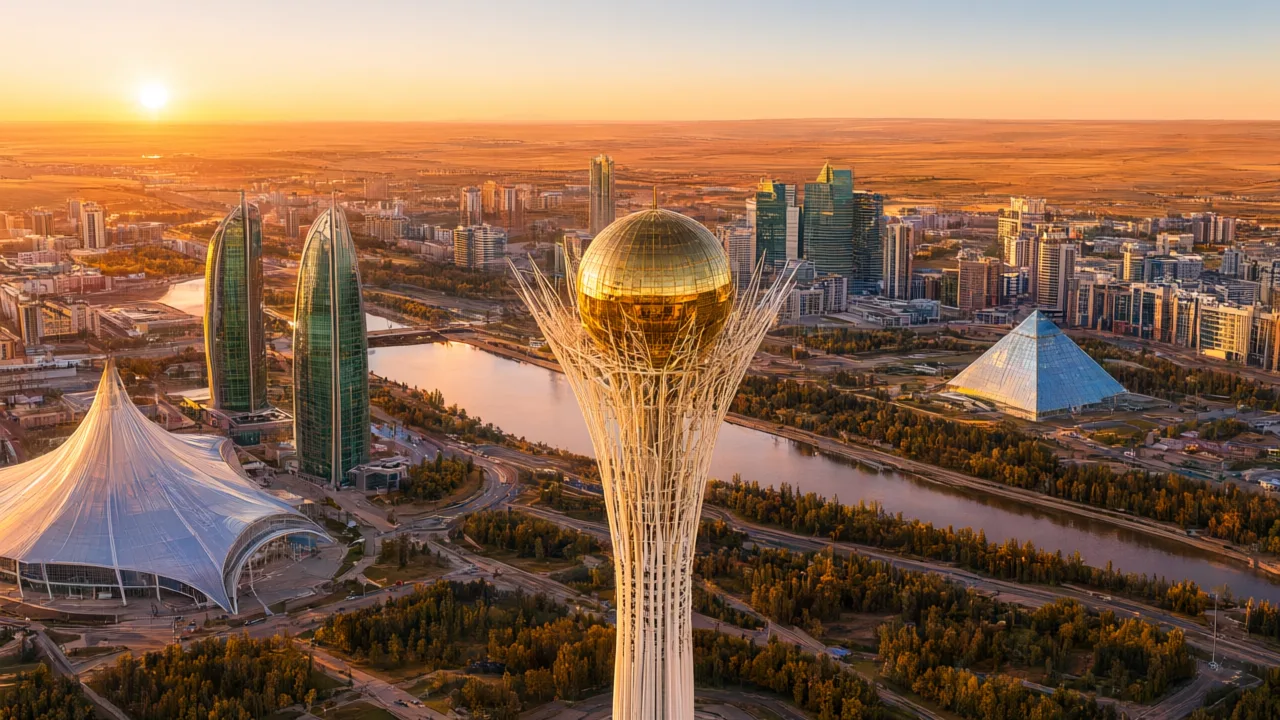
Astana, the capital of Kazakhstan since 1997, is a city purpose-built in the steppe, featuring futuristic architecture that blends large-scale monuments with urban planning based on wide avenues. People travel there to witness an unprecedented urban experiment, where oil and gas money has been transformed into towers, domes, and impossible shapes, and to understand contemporary Kazakh identity, which looks to the future without abandoning its nomadic roots.
What to see
The visual axis of the city is Bayterek Tower, a 97-meter-high structure crowned by a golden sphere representing a mythical bird's egg. From its observation deck, you can see the entire city, and inside there is an exhibition about President Nazarbayev, who promoted the capital's relocation. A few minutes away, Hazrat Sultan Mosque, the largest in Central Asia, impresses with its blue dome and four minarets, featuring a marble interior and carpets that admit visitors outside prayer hours.
The Palace of Peace and Reconciliation, a glass and steel pyramid designed by Norman Foster, is another landmark: it houses an auditorium and a museum of cultures. Equally striking is the Khan Shatyr shopping center, a gigantic transparent tent that creates an indoor microclimate with a beach and palm trees, ideal for understanding how the city's extreme cold is combated.
Neighborhoods and how to get around
The city is divided into two banks of the Ishim River. The right bank is the historical zone, with narrower streets and Soviet-era buildings, while the left bank concentrates the government district and glass skyscrapers. The most recommended walk is Nurzhol Boulevard, which connects Bayterek Tower with the Palace of Peace, flanked by gardens and fountains. To get around, the metro has a single line with three stations, useful for crossing the river, although most trips are made by taxi or bus, as distances are long and the weather does not encourage walking in winter.
Museums and theaters
The National Museum of Kazakhstan, on the left bank, is the country's most comprehensive: it covers everything from the Bronze Age to independence, with a room dedicated to Scythian gold and another to the president's life. Its architecture, with a blue dome and granite facade, is already an icon. The Astana Opera and Ballet Theater, in neoclassical style, offers high-quality performances at accessible prices and is a good option for a cultural evening. Both are about a twenty-minute walk from each other, in the ministries district.
Eating and nightlife
Local cuisine revolves around meat: beshbarmak (pasta with lamb and onion) and manty (steamed dumplings) are essential dishes, served in restaurants such as those on Nurzhol Boulevard. For something more informal, markets offer samsa, baked meat pastries. Nightlife is concentrated in luxury hotels and bars on the left bank, where young Kazakhs and expatriates mix. Prices are higher than in the rest of the country but still lower than in Moscow or Almaty.
Frequently asked questions
How many days do you need to see Astana?
Two full days are sufficient to see the main monuments, the national museum, and take a stroll along the boulevard. If you want to add a trip to the nearby Mausoleum of Khoja Ahmed Yasawi in Turkestan, you will need one more day, although the distance is considerable and is usually done by plane or train.
What is the best time to visit?
From May to September, with mild temperatures and long days, is the most comfortable time. In winter, from December to February, the cold is extreme (it can drop below -30 °C), but the city has a special charm with snow and climate-controlled interiors, and hotel prices drop significantly.